
Beam to beam stub connection (135)
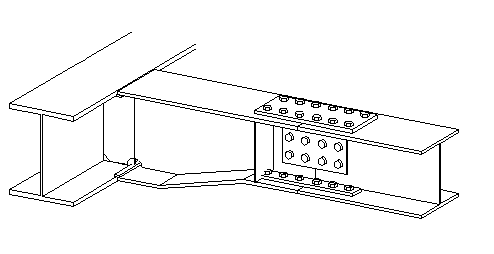
Beam to beam stub connection (135) connects a beam to a beam with a short stub beam that is welded to the main part and spliced to the secondary part. Both the main part and secondary parts are either I or H profiles. The main and secondary part tops lie on the same plane. In some situations, the secondary part can be at a skewed angle to the main part.
Objects created
-
Flange plates
-
Web plates
-
Backing bars
-
Stiffeners
-
Bolts
Use for
| Situation | Description |
|---|---|
|
|
Beam connected to a beam with a short stub beam that is welded to the main part and spliced to the secondary part. |
Selection order
-
Select the main part.
-
Select the secondary part.
The connection is created automatically when the secondary part is selected.
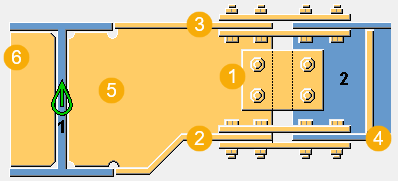
Part identification key
| Description | |
|---|---|
|
1 |
Web plate |
|
2 |
Lower flange plates |
|
3 |
Upper flange plates |
|
4 |
Secondary part stiffener |
|
5 |
Stub beam |
|
6 |
Main part stiffener |
Picture tab
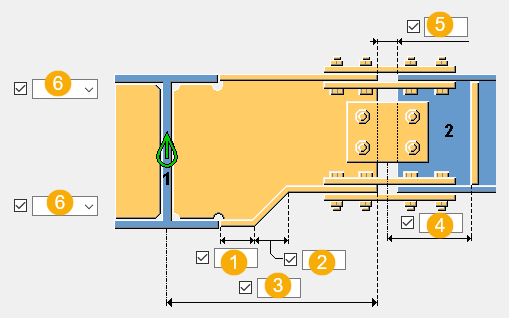
Use the Picture tab to define the connection dimensions, secondary haunch, and fitting type.
Dimensions
| Description | Default | |
|---|---|---|
|
1 |
Dimension of the horizontal part of the lower flange. |
200 mm |
|
2 |
Horizontal distance of the sloped flange measured on the web side (top side of the bottom flange). |
400 mm |
|
3 |
Stub length measured from the main part center line to the splice location. |
1000 mm |
|
4 |
Stiffener offset from the web plate center line. |
50 mm |
|
5 |
Fitting gap between the stub and the secondary part. |
0 |
|
6 |
Position of stub flanges relative to the main part flange. |
Top |
Secondary haunch type
| Oprion | Description |
|---|---|
|
|
Default The web stub plate haunch is created to the main beam. AutoDefaults can change this option. |
|
|
The web stub plate haunch is created to the main beam. |
|
|
No haunch. The web plate is created parallel to the secondary beam. |


Fitting type
| Option | Description |
|---|---|
|
|
Default Fitting is done from the center, half to the secondary beam and half to the stub web plate. AutoDefaults can change this option. |
|
|
Fitting is done from the center, half to the secondary beam and half to the stub web plate. |
|
|
Fitting is done towards the secondary beam. |

Parts tab
Use the Parts tab to define the part properties.
Parts
| Option | Description | Default |
|---|---|---|
|
Upper flange Lower flange |
Thickness and width of the flange plate. |
Plate thickness = secondary part flange thickness Plate width = secondary part flange width |
|
Stub web |
Thickness of the stub web. |
Thickness = secondary part web thickness |
|
Stub stiffeners Prim stiffeners |
Thickness of the stub and main part stiffeners. |
Thickness = secondary part web thickness |
|
Top backing pl Btm backing pl |
Select the profile from the profile catalog. Backing plates are created between the stub and the main part flanges. |
PL25*9 |
|
Top ext flange pl Top int flange pl Btm ext flange pl Btm int flange pl |
Thickness, width, and height of the flange plate. |
|
|
Web plates |
Thickness, width, and height of the web plate. |
|
|
Flange spacers Web spacers |
Thickness of the spacer plates. |
|
|
Backing bar |
Thickness and width of the backing bar. |
|
Option |
Description |
Default |
|---|---|---|
|
Pos_No |
Prefix and start number for the part position number. Some components have a second row of fields where you can enter the assembly position number. |
The default part start number is defined in the Components settings in . |
|
Material |
Material grade. |
The default material is defined in the Part material box in the Components settings in . |
|
Name |
Name that is shown in drawings and reports. |
Parameters tab
Use the Parameters tab to define assembly creation and plate attachment to the main part and secondary part.
Assembly creation
| Option | Description |
|---|---|
|
Loose parts assembly |
|
|
Splice plate assembly |
The assemblies of the splice plates are done with workshop bolts/welds.
|
|
Workshop bolts |
Select where the workshop bolts are attached.
|
Plate attachment
Define how the plates are attached to the main and secondary parts.
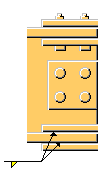
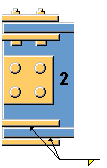
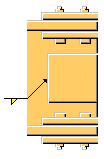
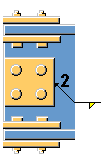
| Main part | Secondary part | Description |
|---|---|---|
|
|
|
Default Plates are bolted to the beam. AutoDefaults can change this option. |
|
|
|
Plates are bolted to the beam. |
|
|
|
Upper plates are welded to the beam. |
|
|
|
Lower plates are welded to the beam. |
|
|
|
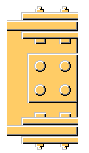
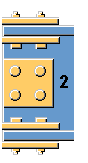
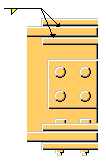
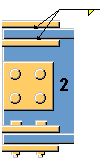
Web plate is welded to the beam. The web plate is also bolted to the secondary part. |
Stiffeners tab
Use the Stiffeners tab define the stiffener position, dimensions, and chamfers.
Main part stiffeners
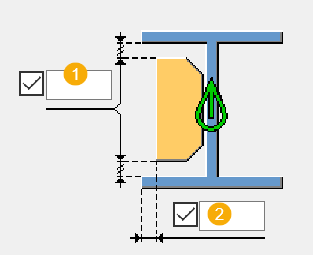
| Description | |
|---|---|
|
1 |
Size of the gap between the main part flanges and the stiffener. |
|
2 |
Distance from the edge of the main part flange to the edge of the stiffener. |
Stub stiffeners
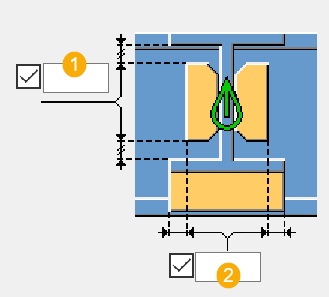
| Description | |
|---|---|
|
1 |
Stiffener vertical distance from the edge of the stub. |
|
2 |
Stiffener horizontal distance from the edge of the stub. |
Chamfer type
|
Option |
Description |
|---|---|
|
|
Default Line chamfer AutoDefaults can change this option. |
|
|
No chamfer |
|
|
Line chamfer |
|
|
Convex arc chamfer |
|
|
Concave arc chamfer |


Chamfer dimensions
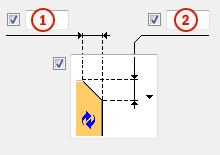
|
Description |
|
|---|---|
|
1 |
Horizontal dimension of the chamfer. |
|
2 |
Vertical dimension of the chamfer. |
Rat hole tab
Use the Rat hole tab to define the weld access holes created between the main part and the stub at the top and bottom.
Weld access hole dimensions
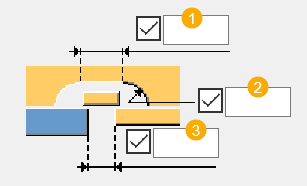
| Description | Default | |
|---|---|---|
|
1 |
Horizontal section of the weld access hole. |
0 mm |
|
2 |
Radius of the weld access hole. Weld access hole is created in the inner corner of the main part flanges. |
35 mm |
|
3 |
Weld gap between the secondary part flange and main part flange. |
2 mm |
Weld backing bar length
Enter the length of the weld backing bar in the box below the options.
|
Option |
Description |
|---|---|
|
|
Default Absolute length of the backing bar AutoDefaults can change this option. |
|
|
Absolute length of the backing bar |
|
|
Extension beyond the edge of the flange |


Chamfer dimension
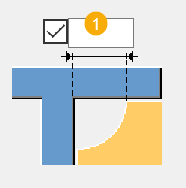
| Description | Default | |
|---|---|---|
|
1 |
Chamfer dimension of the stub web plate. |
35 mm |
Stub web plate chamfer type
| Option | Description |
|---|---|
|
|
Default No chamfer AutoDefaults can change this option. |
|
|
No chamfer |
|
|
Concave chamfer |
|
|
Convex chamfer |
|
|
Line chamfer |




Web bolts tab
Use the Web bolts tab to define the bolt group dimensions and bolt properties.
Bolt group dimensions
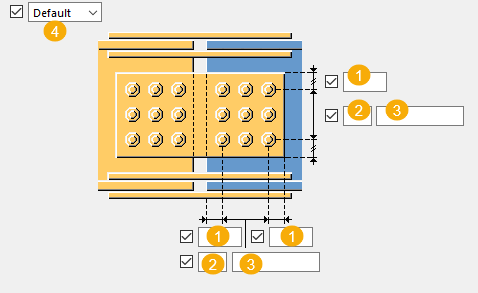
| Description | |
|---|---|
|
1 |
Bolt edge distance. Edge distance is the distance from the center of a bolt to the edge of the part. |
|
2 |
Number of bolts. |
|
3 |
Bolt spacing. Use a space to separate bolt spacing values. Enter a value for each space between bolts. For example, if there are 3 bolts, enter 2 values. |
|
4 |
Select how the bolts are staggered. |
Bolt basic properties
|
Option |
Description |
Default |
|---|---|---|
|
Bolt size |
Bolt diameter. |
Available sizes are defined in the bolt assembly catalog. |
|
Bolt standard |
Bolt standard to be used inside the component. |
Available standards are defined in the bolt assembly catalog. |
|
Tolerance |
Gap between the bolt and the hole. |
|
|
Thread in mat |
Defines whether the thread may be within the bolted parts when bolts are used with a shaft. This has no effect when full-threaded bolts are used. |
Yes |
Slotted holes
You can define slotted, oversized, or tapped holes.
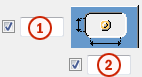
|
Option |
Description |
Default |
|---|---|---|
|
1 |
Vertical dimension of slotted hole. |
0, which results in a round hole. |
|
2 |
Horizontal dimension of slotted hole, or allowance for oversized holes. |
0, which results in a round hole. |
|
Hole type |
Slotted creates slotted holes. Oversized creates oversized holes. No hole does not create holes. Tapped creates tapped holes. |
|
|
Rotate Slots |
When the hole type is Slotted, this option rotates the slotted holes. |
|
|
Slots in |
Part(s) in which slotted holes are created. The options depend on the component in question. |
Bolt assembly
The selected check boxes define which component objects (bolt, washers, and nuts) are used in the bolt assembly.
If you want to create a hole only, clear all the check boxes.
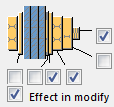
To modify the bolt assembly in an existing component, select the Effect in modify check box and click Modify.
Bolt length increase
Define how much the bolt length is increased. Use this option when, for example, painting requires the bolt length to be increased.

Flange blt tab
Use the Flange blt tab to define the bolt group dimensions and bolt properties.
Bolt group dimensions
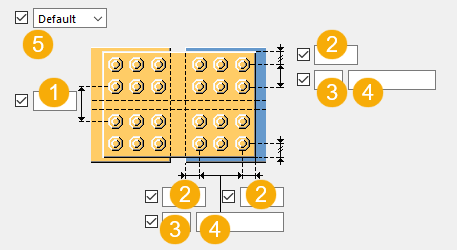
| Description | |
|---|---|
|
1 |
Dimension for vertical bolt group position. |
|
2 |
Bolt edge distance. Edge distance is the distance from the center of a bolt to the edge of the part. |
|
3 |
Number of bolts. |
|
4 |
Bolt spacing. Use a space to separate bolt spacing values. Enter a value for each space between bolts. For example, if there are 3 bolts, enter 2 values. |
|
5 |
Select how the bolts are staggered. |
Bolt basic properties
|
Option |
Description |
Default |
|---|---|---|
|
Bolt size |
Bolt diameter. |
Available sizes are defined in the bolt assembly catalog. |
|
Bolt standard |
Bolt standard to be used inside the component. |
Available standards are defined in the bolt assembly catalog. |
|
Tolerance |
Gap between the bolt and the hole. |
|
|
Thread in mat |
Defines whether the thread may be within the bolted parts when bolts are used with a shaft. This has no effect when full-threaded bolts are used. |
Yes |
Slotted holes
You can define slotted, oversized, or tapped holes.
|
Option |
Description |
Default |
|---|---|---|
|
1 |
Vertical dimension of slotted hole. |
0, which results in a round hole. |
|
2 |
Horizontal dimension of slotted hole, or allowance for oversized holes. |
0, which results in a round hole. |
|
Hole type |
Slotted creates slotted holes. Oversized creates oversized holes. No hole does not create holes. Tapped creates tapped holes. |
|
|
Rotate Slots |
When the hole type is Slotted, this option rotates the slotted holes. |
|
|
Slots in |
Part(s) in which slotted holes are created. The options depend on the component in question. |
Weld prep tab
Use the Weld prep tab to define the weld access hole dimensions and web plates. Flange welds and weld preparations are only created if the flange plates do not exist. Flange plates are not created if the thickness is set to zero.
Dimensions
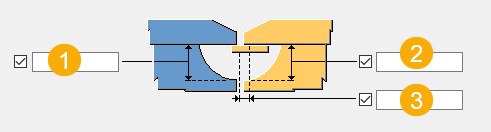
| Description | |
|---|---|
|
1 |
Weld access hole radius for the main part. Enter a value to create the hole. |
|
2 |
Weld access hole radius for the secondary part. Enter a value to create the hole. |
|
3 |
Weld backing bar offset in the direction of the secondary beam. |
Web plates
| Option | Description |
|---|---|
|
|
Default Both web plates are created. AutoDefaults can change this option. |
|
|
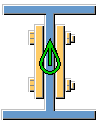
Both web plates are created. |
|
|
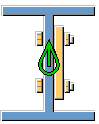
Web plate is created on the right side. |
|
|
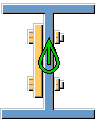
Web plate is created on the left side. |
General tab
Click the link below to find out more:
Analysis tab
Click the link below to find out more:
Welds
Click the link below to find out more: